Tuesday, March 17, 2015

New Handpaint Colors in Lana Boucle

Feast your eyes on this scrumptious swatch of our newest handpaint in Lana Boucle. "Candy Corn" will make a vibrant autumn sweater or accessory.

This handpaint coordinates charmingly with our lineup of solid Lana Boucle colors, especially Dark Mahogany, Cayenne Pepper, Golden Sunbeam, Deep Garnet, and/or Robust Raisin.
Lana Boucle is Brown Sheep Company's newest line of yarn.  If you are not familiar with boucle yarn, it is made with strand of thicker wool wrapped around a thinner strand, giving the yarn a twisty look.
Brought to you from beautiful Western Nebraska


Thursday, March 12, 2015

Having a Blast with Jane Austen Knits

It's not very often you find a book where you LOVE every single pattern. Ever since we got The Best of Jane Austen Knits in the mail, I've been nearly obsessed with it.  Not only are the patterns super classy, they are interspersed with articles about the history of knitting around Jane Austen's era. I was fascinated to learn that in the early 1800s, knitting was considered a craft for the poor. The ladies of high society would not have partaken in knitting, at least until Queen Victoria made knitting fashionable in the mid-1800s.

Knitting needles were often given to teenage girls as they left an orphanage, so that they could financially support themselves by knitting stockings.  During this era, men knit as well, especially wagon drivers who would knit stockings to earn some extra income. Although times have changed and knitting is purely a hobby for many people, I believe knitting still gives that sense of empowerment like it did over 200 years ago. Think of inmates who knit or crochet in order to save up some wages, or the many people who now earn extra income by selling handmade projects on Etsy or at fairs or farmer's markets.
I decided to knit the Sweetheart Bag pattern first.  It's the perfect tiny sized colorwork project: challenging (for me), but small enough not to take forever.

I chose 2 colors in Nature Spun Fingering, Olive Spring (NS149) and Natural (NS730).

Two-handed colorwork is so much fun to knit. For this project I learned how to wrap the carried strand on the wrong side so that my "floaters" were no longer than 4 stitches.

 
I found it very helpful to highlight the chart as I went along
Finished Sweetheart Bag! It will make a nice small-project bag.
Since there were so many floaters, I decided to line the bag with fabric. That's our puppy Purl in the background.


My mom knit the pattern called Pemberley Reticule. (Word of the day: reticule-- a woman's small handbag, originally netted and typically having a drawstring and decorated with embroidery or beading.) This beautiful reticule goes over the shoulder and is big enough to use as a shopping bag. Or perhaps, a bag in which to carry yarn.
Pemberley Reticule in Cotton Fleece Jubilant Jade (CW452)
The tied handles are lace-leaf shaped

I love the lace work on the bottom of the bag!
Snowshoeing + knitting = lots of fun!
I would highly recommend The Best of Jane Austen Knits book, especially because of the written articles. However you can also purchase these patterns on Ravelry:
Sweetheart Bag by Donna Kay
Pemberley Reticule by Catherine Salter Bayar

Here is the book info:
Edited by Amy Clarke Moore
Interweave/F+W; $22.99
http://bit.ly/1xL3S8H


Tuesday, March 3, 2015

Learning to Spin on THE Wheel that Inspired Brown Sheep Company

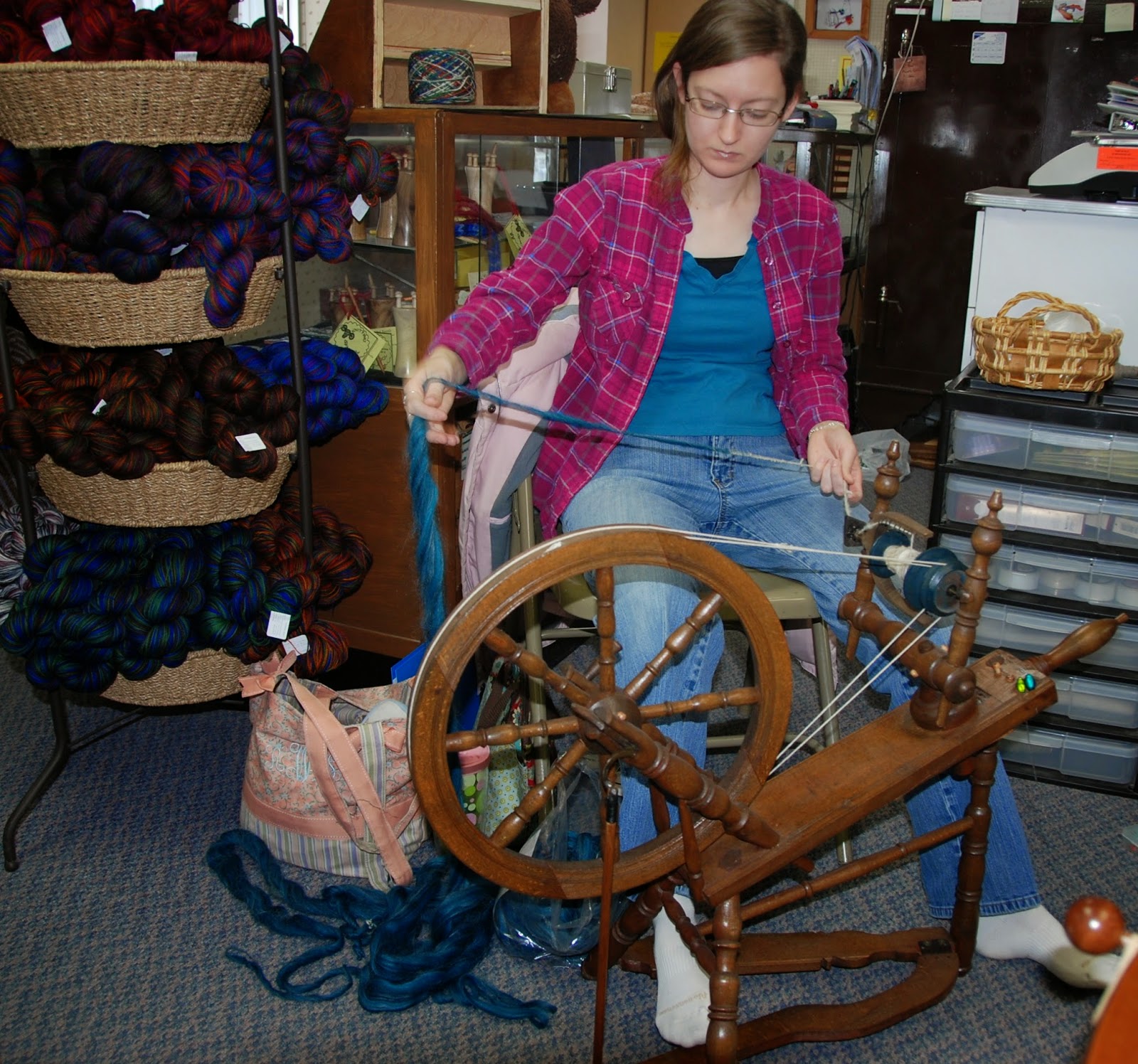
I got to spend this Saturday spinning yarns with a group of women--literally. In fact, Brown Sheep Company might never have existed if it hadn't been for this lovely Ashford spinning wheel.
Peggy Jo Wells (Brown) was given this wheel as a Christmas gift from her parents, Janet and Harlan Brown.  Harlan took a liking to spinning with the wheel, and before long was inspired to begin the wool spinning mill we now know as Brown Sheep Company.
This weekend's class was taught by Katrina Tylee, who is our local farmer's market director and a former airplane mechanic. Kat described spinning as similar to patting your head while rubbing your belly--this was a very accurate description.  Spinning on a wheel requires treadling, or pedaling with your foot to keep the wheel spinning, while simultaneously feeding roving fibers into the wheel.
 Each of us taking the class had brought a different kind of spinning wheel. It was fascinating to watch each person learn to use their wheel.

This wheel, called a charkha, is especially unique. The charkha is one of the oldest styles of spinning wheels, originating India.  It is intended mainly for spinning with cotton and was made famous by Gandhi, who spun on a charkha and saw it as a symbol of self-sufficiency and independence.
Shawntae's wheel was made for spinning flax.  She found this wheel at an antique shop and refinished it. Since this week was made for very small fibers, Shawntae's wheel was extra challenging but she was spinning impressively well by the end of the day.
When I was a kid, my greatest dream was to be Laura Ingalls of Little House on the Prairie. Spinning on a wheel was greatly fulfilling to that eleven-year-old part of my self. There's just something very satisfying about creating something useful with your hands. Even if it looks like this:
I know this only slightly resembles yarn, but I spun it!
If you are already in to some kind of fiber arts, but haven't tried spinning, I would highly recommend it. Spinning will give you a true appreciation for what it means to make clothing "from scratch." We knitters are pretty spoiled to have yarn that's already been spun and dyed at our fingertips. Just imagine how much work it took to produce clothing when everything was done by hand.


Wednesday, February 11, 2015

The Saga of the Rainbow Striped, Fair Isle, Thigh-High Socks

Peek-a-Boots are available from Skacel here
The saga began with a pair of clear, rubber boots. Last spring I was helping at a yarn show in Loveland, CO where one of the yarn shops was selling these clear "Peek-A-Boots", specifically designed so that fancy socks can show through. My (soon to be) mother-in-law, Peggy, insisted on getting a pair of these boots for me.

Along with the clear boots came a challenge: to knit a pair of socks worthy of being seen THROUGH boots. I was planning to go to The National Needle Arts (TNNA) trade show with Brown Sheep Company, where I hoped to wear the boots with the fancy-schmancy socks I would make. A few weekends later at the family cabin, Peggy brought me two options with yarn: one pattern was fun but well within my comfort zone as a knitter; the other pattern had more intimidating multi-colored stripes with fair isle colorwork. As someone who tends to choose type 2 fun (type 2 fun is the kind that's not fun at the time, but fun to look back on later: for example, marathon running, rock climbing, and bicycling through a hailstorm), of course I would take on the tough sock pattern.
Photo Copyright Joe Hancock.

The pattern is called Thigh-High Stripes by Deborah Newton. It's published in the book Sock Knitting: Master Class by Ann Budd. Click this link to see the pattern on Ravelry.

Now, at this point, as I was getting to know the Wells (Brown Sheep) family, it became apparent that they favored continental-style knitting as the "industry standard" over the "throwing" or English-style of knitting I had learned. Clearly I would need to convert from "throwing" to "picking" if I were to impress them.

Luckily, 2-handed color knitting is one of the best ways to learn continental knitting.  With this technique, you hold one color in your right hand and "throw" English-style, while you hold the other color in your left hand and "pick" those stitches continental-style.  This technique goes much faster than one-handed colorwork, plus your two colors don't get tangled.

I began knitting intently on the first sock. The continental knitting felt very awkward at first and I struggled to keep my tension even.  I spent an embarrassing amount of time working on this sock (as I only had a part-time job at the time) and made it this far:
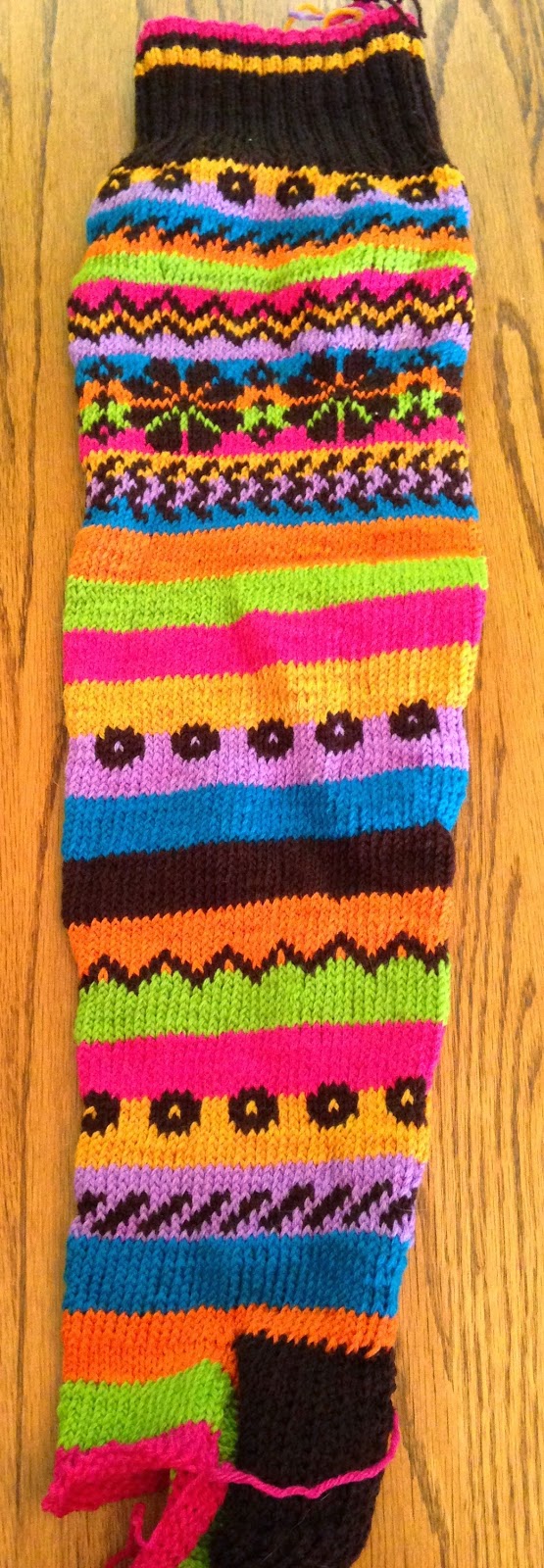

I guess this will make a good wind sock.
. . . until I showed the sock to Peggy.   As she looked at the sock, hours and hours of knitting, her face fell as she broke the news to me. "Did you know you have twisted almost all of your stitches?" It was true; every stitch I had knit continental-style was twisted.  I had thought my tension was just really bad, but in fact, I was knitting each stitch backwards. Furthermore, this sock was simply too big and would never be wearable by me. The only good option, at this point, was to completely start over with a new sock.
This is what twisted stitches look like.

If at first you don't succeed... So I changed needle sizes and re-learned how to properly knit a continental stitch. The National Needle Arts show was only a few weeks away, so I would need to knit frantically to get the socks done in time. Maybe it seems silly, but sometimes in life you need a mission to conquer.
Finally, I finished the second sock in the airplane on the way to the show.  Peggy was nice enough to help me weave in the ends (this project had a LOT of ends to weave in!). I got to show off my socks at the trade show, but more importantly, I got to feel the satisfaction of completing my most challenging knitting project yet.
The finished product. I used Wildfoote Sock Yarn in Rose Bud (SY50), Volcanic Blast (SY51),  Deco Lime (SY44), Goldenrod (SY45), Blue Bird (SY53), Little Lilac (SY32) and Walnut Bark (SY52)
Although I got to make a fashion statement, the boots were not incredibly breathable.


Lessons learned: Consulting an experienced knitter for help in person is much more effective than consulting YouTube. Take the pattern gauge seriously and don't be lazy about the gauge. Don't give up on a project if you make a big mistake--learn from it.

Friday, January 30, 2015

"Casting On" a New Life Together: Our Yarn-Inspired Wedding


Of course it made sense to have a yarn-themed wedding, especially for a January wedding. Knit and crocheted flowers were especially meaningful because they were all handmade by loved ones: my mother-in law, my mom, my aunt, my bridesmaids, and me.  Wedding planning has a reputation for being highly stressful, so what better way to de-stress than to knit things for the wedding?  Plus, flowers made with wool will last forever.
The pastor even wrote the homily for our wedding based on metaphors for knitting and marriage. This part of the ceremony was a surprise to us on the day of the wedding and it was absolutely beautiful; I wish you all could have heard it.
My mother-in-law, who is an amazing knitter, actually bought a live calla lily to pull apart and construct her own pattern for felted calla lilies. These turned out to look exactly like real calla lilies, but much sturdier and heavier.


Pattern information for everything is at the end of the post!
Photo by Anne Brande, Ludwig Photograpy, Laramie, WY


The bridal bouquet is made with felted calla lilies and crocheted carnations


Photo by Anne Brande

Mason jar centerpieces with crocheted carnations


Wrist corsages with knit roses, pine, pearl beads, and berries for mother of the bride, mother of the groom, and grandmothers


Bridesmaids bouquets with knit flowers, crocheted carnations, pinecones, and wrapped in burlap


The ring bearer's pillow knit with Lamb's Pride Worsted
Felted flower girl baskets for the adorable flower girls
Arrangement of yarn flowers in a watering can, complete with pheasant feathers and pinecones
Yep, even the cake was decorated with knit flowers.
Good thing I took Floral Arrangement 101 in college! I had way too much fun arranging the flowers.
Here we are!
Photo by Anne Brande

Pattern Info:
The carnations used in the centerpieces and bouquets were made using this free pattern from Maggie's Crochet. Nature Spun Sport in Boysenberry was used for the smallest carnations, Nature Spun Worsted in Natural was used for the medium-sized carnations, and Lanaloft Bulky in Cottage White was used for the largest carnations.
The roses were knit using the Scallop Rose pattern from the book Nicky Epstein's Knitted Flowers. Here is the Scallop Rose pattern on Ravelry. These roses were made both in Nature Spun sport (Boysenberry) and Nature Spun Worsted (Natural).
The Ring Bearer's Pillow by Lorna Miser pattern information is on Ravelry. The pillow was made with Lamb's Pride Worsted in Amethyst.
The Felted Flower Girls' Baskets are made from a free Ravelry pattern for Easter baskets by Mary Lue. These were made using Nature Spun Chunky in True Blue Navy and a sparkly novelty yarn.

Coming soon: the exclusive pattern for beautiful felted calla lilies designed by Peggy Jo Wells!


Friday, January 23, 2015

What Knitting Means to Me

Hello knitters and friends! I'm Brittany (Bunker) Wells, your newest Brown Sheep Co. blogger. After you read this post, I would love to hear what knitting/crocheting/weaving/needlepoint means to YOU!
Knitting for me has been a solace, a way to bond with the people in my life, and. . . oh yeah, I met my soulmate because of knitting.
I was initiated into the world of knitting my freshman year of college, taught by my friend in the dorms. Although I struggled through my first not-so-pretty scarf, I was hook, line, and sinker-ed by my second scarf.  Before long, some friends had decided to start a student organization for knitting and crocheting called United by Yarn.  The girls in this group were sweet and smart, girls who would rather talk about books and bicycles than gossip.  I felt like I had found my tribe.  These lifelong friends would go on to be my roommates and bridesmaids.  It's truly amazing how getting together in a circle to play with yarn every week can form such bonds.
Of course, I had to share my new-found love of knitting with my mom over Christmas break.  Like me, it didn't take long for her to become a yarn addict. We would knit together for hours when I was home from college, and would constantly text each other pictures of our current projects. Mom and I began an annual trip to Chicago to visit my older brother and to check out the Vogue Knitting Live convention.
Curling up on the couch with knitting was one of my greatest comforts after a bicycle accident that left me with a fractured foot. On cold winter days, a hand-knit scaft was the closest thing to a warm hug from my mother or my good friend.  I wanted to share this feeling with everyone I loved--to wrap them in the warmth of something knit with my love. So I knit scarves and hats and mittens to show the people in my life how much I cared about them.
Now we get to the cutesy, romantic part of What Knitting Means to Me.  Mom and I traveled to the Scottsbluff Valley Fiber Arts Fair, expecting to buy some nice yarn and take a tour of the Brown Sheep Company wool mill.  The very last thing I expected was to meet the handsome, well-spoken young man who would become my husband there.  This young man, who was our tour guide through the mill, talked about yarn with such enthusiasm (if you are already a yarn fanatic, you will understand why this caught my attention!), and the more he talked about backpacking, biking, and adventures, it seemed that we had the same passions in common.  To make a long story short, after much teasing from my mom (who could tell I had a crush on him), I got in touch with this young man. A year and a half later we were married.
So, my journey with knitting has brought me here to Brown Sheep Company.  Stay tuned to our blog for pictures of the yarn-themed wedding. :)
I might be enjoying this job, just a little bit