Friday, May 22, 2015

A Spring Sweater

Here in Nebraska, it doesn't quite feel like spring yet. We've had two snow storms in May. . . but it will get warm and sunny soon, right?
For many people, knitting is a fall and winter activity. But for some of us, the yarn obsession carries over into all four seasons. It can be hard to find a project that's appealing to work on (and wear) in warm weather. Non-fuzzy yarn such as cotton is a must for spring/summer knitting. Here's a lovely spring sweater knit in Cotton Fine by my mom. (I'm tempted to "steal" this sweater like I often do with her knitting projects!)
If you're not familiar with Cotton Fine, it's a fingering-weight blend of 15% wool and 85% cotton. Did you know it's available in 1000 yard cones?!

Not only is the fiber nice to wear, lace work gives this sweater an airy, light feel. The pattern is called India Print Henley by Ann Hanson. It can be found in The Knitter's Handy Book of Top-Down Sweaters by Ann Budd.


Beautiful!

May you be inspired to keep your knitting needles busy this summer. :)

Tuesday, May 12, 2015

Scandinavian Band Weaving


Learning to weave has been on my bucket list for a long time--since way before I ever imagined I would live right next to a yarn factory. A small band weaving project seemed like a good way to dip my toes in to weaving. Especially since Nancy Shroyer, a fantastic teacher, was offering a workshop in German Pennsylvanian/Scandinavian band weaving at the Interweave Yarn Fest last month.
Admittedly I was exhausted after three days of selling yarn, so I was relieved to find band weaving relaxing and enjoyable, and not incredibly difficult. Nancy designed her method of band weaving to be portable--all you need is a clamp, a small rigid heddle, and a few odds and ends that can easily fit in a small bag. Plus, it's much less expensive than buying a loom.
Some of Nancy's examples, including a dog leash and keychain. Can't wait to make a leash for our dog Purl!

Students in action band weaving at the YarnFest

My first project had some sections with very uneven edges, so I decided to cut out the ugly parts and make a shorter headband.  I came to appreciate how sturdy woven fabric is--it's actually rather hard to undo weaving. I'm used to knitting which can easily come unraveled with a slight tug.


My first woven band with Cotton Fleece

Modeling my woven headband--excuse the dorky selfie


This method of band weaving is simple enough, it would be a great project for kids. I've already started weaving another band:


Setting up the warp takes the most time. The warp will also create the pattern.

Almost finished! I'm hoping to make this one a belt.


If you want to get started band weaving, here's a book recommended by Nancy:
 

 Until next time. . . happy making!

Wednesday, April 29, 2015

Free (& Adorable) Patterns for Babies

What's cuter than a hand-knit sweater for an adorable baby? Did you know that we have been putting many of the Brown Sheep Original patterns up for free on Ravelry? Just in case you are looking for a baby pattern, here are some cute options for you. Even if you are not, the cute pictures of babies will make you smile.
Jumps & Bumps Sweater & Hat by Lorna Miser
http://www.ravelry.com/patterns/library/jumps--bumps-sweater--hat
Daffodil Sweater and Hat by Lorna Miser
http://www.ravelry.com/patterns/library/daffodil-sweater--hat
Cozy Posy Sweater and Hat by Lorna Miser
http://www.ravelry.com/patterns/library/cozy-posy-sweater--hat
Baby Boy Vest by Lorna Miser
http://www.ravelry.com/patterns/library/baby-boy-vest
Baby Girl Vest by Lorna Miser
http://www.ravelry.com/patterns/library/baby-girl-vest-3

Happy knitting! :)

Tuesday, April 7, 2015

All About WOOL

Caution: nerd alert! (Admit it, if you are a knitter or crocheter you probably have a bit of a nerdy side)
If you're not already a yarn snob, you are about to learn some good reasons to become one. Why? The kind of fiber your yarn is made of makes a huge difference!
 
Image from CSIRO
 
Check out this electron microscope image of a wool fiber. Wool is a natural protein fiber, similar to human hair in that it's made of a keratin-like protein. This fiber has some amazing properties:
 
Felting: When wool is agitated with heat and moisture,  the scales of the edges of wool fibers interlock, creating a durable fabric. Felting is great for creating warm, durable projects such as clogs, mittens, and bags. However, it can be a bummer when a wool garment accidentally is thrown in the washing machine, since felting shrinkage is irreversible.
 
Copyright Fiber Trends
 
Flexibility and Durability: the molecular structure of each wool fiber is a coiled spring, making the fiber very elastic. This flexibility also makes the fiber more durable: a wool fiber can be bent back on itself more than 20,000 times without breaking, compared to about 3,000 times for cotton and 2,000 times for silk.
 
Water Absorbency: Wool is considered a hygroscopic fiber, meaning it takes up moisture in vapor form. Tiny pores in the fiber will take up moisture from its environment, and also release moisture in drier conditions. Wool is especially comfortable to wear because it keeps a layer of air next to the skin. As wool absorbs moisture, it actually generates heat! The hydrogen bond of water is broken and chemically reacts with molecules of wool to generate heat. This makes wool ideal for absorbing sweat and providing protection against hypothermia. For these reasons wool is worn in desert regions of the world where it's hot in the daytime and cold at night.
 
 
Resistance to Flame: Wool blankets can be used to extinguish small fires because wool is self-extinguishing. Wool contains moisture in every fiber, so it will not support combustion.
 
Takes Dye Beautifully: Wool absorbs dye into the inner core of the fiber, where a chemical reaction occurs making the color change permanent except under extreme conditions. Wool is an amphoteric, meaning the fiber takes in both acidic and basic dyes. This means that wool can be dyed in an incredibly wide array of beautiful colors!


Wow! Wool is amazing. Have fun with your favorite fiber art. :)


Tuesday, March 17, 2015

New Handpaint Colors in Lana Boucle

Feast your eyes on this scrumptious swatch of our newest handpaint in Lana Boucle. "Candy Corn" will make a vibrant autumn sweater or accessory.

This handpaint coordinates charmingly with our lineup of solid Lana Boucle colors, especially Dark Mahogany, Cayenne Pepper, Golden Sunbeam, Deep Garnet, and/or Robust Raisin.
Lana Boucle is Brown Sheep Company's newest line of yarn.  If you are not familiar with boucle yarn, it is made with strand of thicker wool wrapped around a thinner strand, giving the yarn a twisty look.
Brought to you from beautiful Western Nebraska


Thursday, March 12, 2015

Having a Blast with Jane Austen Knits

It's not very often you find a book where you LOVE every single pattern. Ever since we got The Best of Jane Austen Knits in the mail, I've been nearly obsessed with it.  Not only are the patterns super classy, they are interspersed with articles about the history of knitting around Jane Austen's era. I was fascinated to learn that in the early 1800s, knitting was considered a craft for the poor. The ladies of high society would not have partaken in knitting, at least until Queen Victoria made knitting fashionable in the mid-1800s.

Knitting needles were often given to teenage girls as they left an orphanage, so that they could financially support themselves by knitting stockings.  During this era, men knit as well, especially wagon drivers who would knit stockings to earn some extra income. Although times have changed and knitting is purely a hobby for many people, I believe knitting still gives that sense of empowerment like it did over 200 years ago. Think of inmates who knit or crochet in order to save up some wages, or the many people who now earn extra income by selling handmade projects on Etsy or at fairs or farmer's markets.
I decided to knit the Sweetheart Bag pattern first.  It's the perfect tiny sized colorwork project: challenging (for me), but small enough not to take forever.

I chose 2 colors in Nature Spun Fingering, Olive Spring (NS149) and Natural (NS730).

Two-handed colorwork is so much fun to knit. For this project I learned how to wrap the carried strand on the wrong side so that my "floaters" were no longer than 4 stitches.

 
I found it very helpful to highlight the chart as I went along
Finished Sweetheart Bag! It will make a nice small-project bag.
Since there were so many floaters, I decided to line the bag with fabric. That's our puppy Purl in the background.


My mom knit the pattern called Pemberley Reticule. (Word of the day: reticule-- a woman's small handbag, originally netted and typically having a drawstring and decorated with embroidery or beading.) This beautiful reticule goes over the shoulder and is big enough to use as a shopping bag. Or perhaps, a bag in which to carry yarn.
Pemberley Reticule in Cotton Fleece Jubilant Jade (CW452)
The tied handles are lace-leaf shaped

I love the lace work on the bottom of the bag!
Snowshoeing + knitting = lots of fun!
I would highly recommend The Best of Jane Austen Knits book, especially because of the written articles. However you can also purchase these patterns on Ravelry:
Sweetheart Bag by Donna Kay
Pemberley Reticule by Catherine Salter Bayar

Here is the book info:
Edited by Amy Clarke Moore
Interweave/F+W; $22.99
http://bit.ly/1xL3S8H


Tuesday, March 3, 2015

Learning to Spin on THE Wheel that Inspired Brown Sheep Company

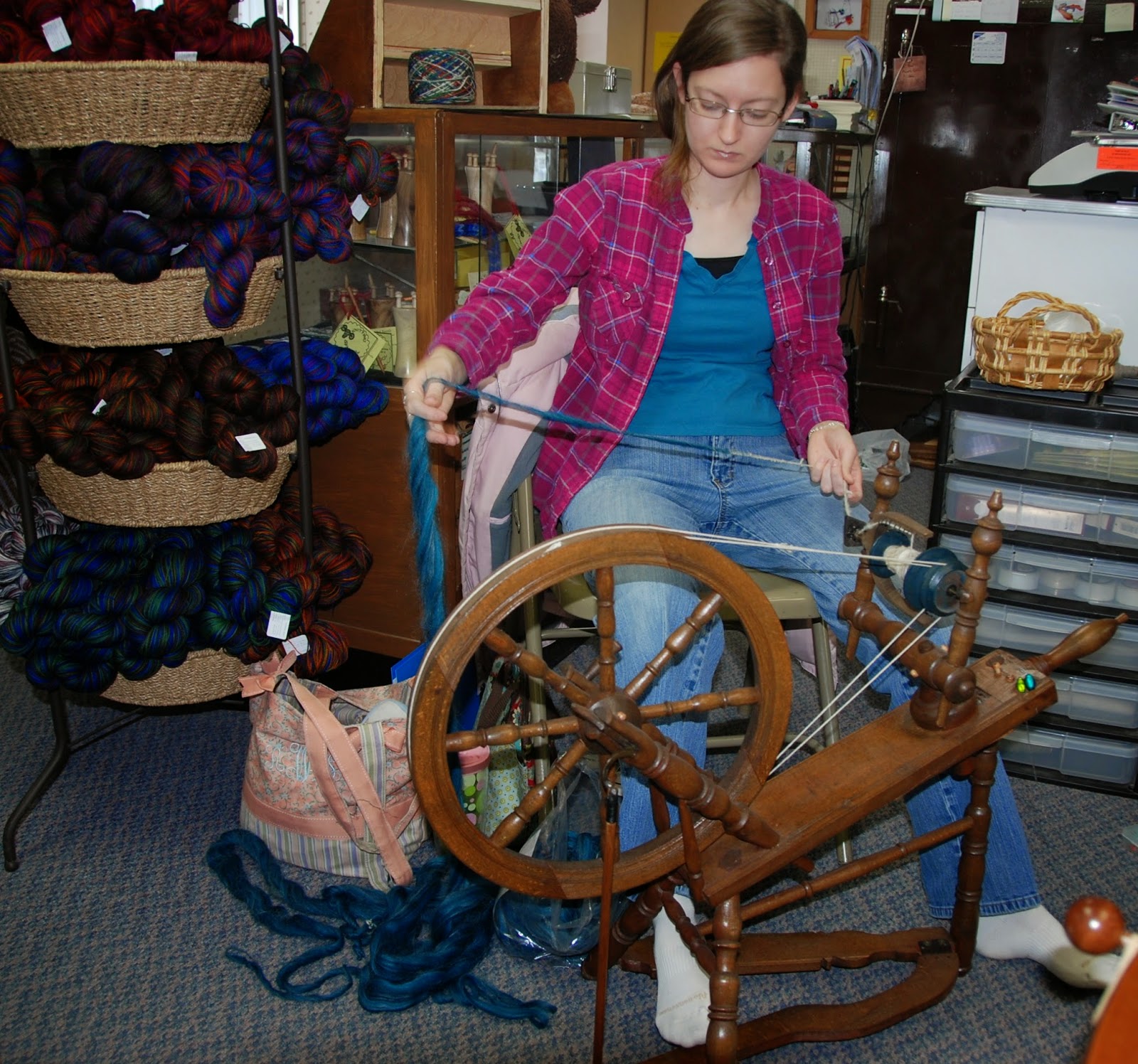
I got to spend this Saturday spinning yarns with a group of women--literally. In fact, Brown Sheep Company might never have existed if it hadn't been for this lovely Ashford spinning wheel.
Peggy Jo Wells (Brown) was given this wheel as a Christmas gift from her parents, Janet and Harlan Brown.  Harlan took a liking to spinning with the wheel, and before long was inspired to begin the wool spinning mill we now know as Brown Sheep Company.
This weekend's class was taught by Katrina Tylee, who is our local farmer's market director and a former airplane mechanic. Kat described spinning as similar to patting your head while rubbing your belly--this was a very accurate description.  Spinning on a wheel requires treadling, or pedaling with your foot to keep the wheel spinning, while simultaneously feeding roving fibers into the wheel.
 Each of us taking the class had brought a different kind of spinning wheel. It was fascinating to watch each person learn to use their wheel.

This wheel, called a charkha, is especially unique. The charkha is one of the oldest styles of spinning wheels, originating India.  It is intended mainly for spinning with cotton and was made famous by Gandhi, who spun on a charkha and saw it as a symbol of self-sufficiency and independence.
Shawntae's wheel was made for spinning flax.  She found this wheel at an antique shop and refinished it. Since this week was made for very small fibers, Shawntae's wheel was extra challenging but she was spinning impressively well by the end of the day.
When I was a kid, my greatest dream was to be Laura Ingalls of Little House on the Prairie. Spinning on a wheel was greatly fulfilling to that eleven-year-old part of my self. There's just something very satisfying about creating something useful with your hands. Even if it looks like this:
I know this only slightly resembles yarn, but I spun it!
If you are already in to some kind of fiber arts, but haven't tried spinning, I would highly recommend it. Spinning will give you a true appreciation for what it means to make clothing "from scratch." We knitters are pretty spoiled to have yarn that's already been spun and dyed at our fingertips. Just imagine how much work it took to produce clothing when everything was done by hand.